H.H. Holmes And The Murder Castle Site In Chicago: A Visitor's Guide
The H.H. Holmes Murder Castle is one of the most searched dark-history stories in Chicago, and almost nothing of it survives. This guide covers where the building stood, what stands there now, and how to hear the story on a tour.
Short answer
The H.H. Holmes Murder Castle stood at 63rd and Wallace in Englewood, on the South Side. The building was demolished, and the site is now occupied by the Englewood branch post office, built in the 1930s, at 611 W. 63rd Street. There is no historical marker. Walking tours in the Loop and River North tell the Holmes story among Chicago's other dark history.
The H.H. Holmes Murder Castle is the most famous address in Chicago's dark history that you cannot actually visit. The building that earned the nickname stood in Englewood, on the South Side, and it has been gone for the better part of a century. What remains is an ordinary corner at 63rd and Wallace, a working post office, and a story that guides across the city still tell with real relish. This guide lays out what is verified about the site, what a visitor can see today, and how the walking tours, bus tours, and ghost hunts on this site handle the Holmes legend.
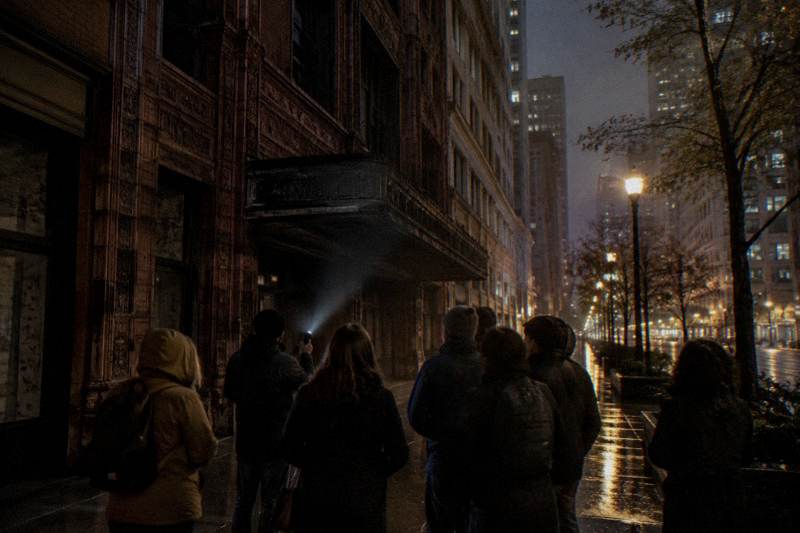
Holmes fans usually arrive with a specific question: can I stand where the castle stood? The honest answer is yes, from the sidewalk, and there is nothing there that announces itself. The better experience for most visitors is a guided dark-history walk in the Loop or River North, where the Holmes story sits alongside the Eastland disaster, the Iroquois Theatre fire, and the gangster era in one connected narrative. The Gangsters and Ghosts minibus tour, 2 hours and from $60 per person, is the tour on this site that carries that story most directly, with a Grant Park and H.H. Holmes stop.
Where Was The H.H. Holmes Murder Castle In Chicago?
The Murder Castle stood at the corner of 63rd and Wallace in Englewood, on Chicago's South Side, and the address today is 611 W. 63rd Street. That corner is now occupied by the active Englewood branch of the United States Postal Service. The earlier building was demolished, and the post office that replaced it was constructed in the 1930s on the same footprint.
Englewood in the Holmes era was a busy commercial neighborhood, and the castle's location near the rail lines and the crowds drawn by the 1893 World's Fair is part of why the building became known the way it did. The structure itself was a large three-story brick building with a mixed reputation from the start: part pharmacy, part hotel, part rental rooms, and, according to the stories that grew around it, a confusing interior of hidden rooms and odd staircases. What is solidly verified is narrower than the legend. The building existed at that corner, it was associated with H.H. Holmes, it was damaged by fire, and it was eventually torn down.
The absence of a marker surprises a lot of visitors. The site is documented in detail by researchers and local historians, and the current state of the site is described by dark-tourism researchers, but nothing at street level signals the history. If you want the story told well, a guide is genuinely the way to get it, which is one reason the Dark Side walk in River North has built its narrative around exactly this kind of Chicago history.
What Happened At The Murder Castle In Englewood?
H.H. Holmes is remembered as one of America's first documented serial killers, and the Englewood building became known as the Murder Castle after his crimes came to light. The verified core of the story is his arrest, conviction for murder, and the sensational trial coverage that fixed the castle in Chicago legend. Many of the building's most repeated details come from that newspaper era, not from modern research.
The gap between the documented record and the legend is wide, and honest tours acknowledge it. Holmes was a swindler and a murderer, convicted and sentenced to death, and the press coverage of his trial inflated the castle into a labyrinth of gas chambers and chutes. Later researchers have trimmed the legend back considerably. Some rooms described in the press coverage existed; some almost certainly did not; the interior was never preserved long enough to settle every question. The building burned shortly after Holmes's arrest made it notorious, and what the fire did not ruin, demolition eventually finished.
What makes the story durable is less the architecture than the setting. The 1893 World's Fair drew enormous crowds to the South Side, and the castle sat where travelers could find it. That combination, a city on display and a predator nearby, is the version of the story that tours tell best. The history of the site and its later life as a post office block is documented by local Chicago writers, and it is that arc, crime, fire, demolition, ordinary commerce, that gives the Holmes stop its weight.
For planning purposes, treat the Murder Castle as a story rather than a destination. The corner is a ten-minute walk from the Englewood Metra station area, but there is no exhibit, no plaque, and no gift shop. Visitors who want the full Holmes experience pair a dark-history walking tour with a short South Side detour, and spend the rest of the evening on the guided route.
Which Chicago Tours Tell The Holmes And True Crime Story?
The tour listed here that carries the Holmes story most directly is Chicago's Dark Side: Ghosts, Gangsters, and True Crime Tour, a two-hour small-group walk in River North, $35 per person, rated 4.9 across 80 reviews. No commercial tour enters the Englewood site itself; the story is told on dark-history walks and bus routes across the Loop, River North, and the South Loop.
That distinction matters. The castle is a South Side address, but the tour economy that tells its story runs through the downtown core, where Holmes-era landmarks, gangster sites, and haunted hotels cluster within walking distance. The Dark Side walk caps its groups at 20, which keeps the storytelling intimate enough that questions about Holmes and the legend's exaggerations actually get asked and answered. It meets in River North in front of the FedEx store, runs about two hours, and lists free cancellation.
Several other formats tell overlapping stories. The Gangsters and Ghosts walk in the Loop, $31 per person and rated 4.7 across 1,878 reviews, spends two hours on the riverfront and includes a stop inside the Palmer House, a hotel with its own body of reported ghost stories. The Mob Alleys walk out of the Congress Plaza Hotel, $34 per person and rated 4.7 across 469 reviews, covers the South Loop's crime history in ninety minutes to two hours. For Holmes fans, the Dark Side walk is the closest thematic match; the gangster walks add the era that followed Holmes by a generation.
The bus tours cover more ground. The Crime and Mob coach tour from Streeterville, $49 per person and rated 4.6 across 3,603 reviews, runs ninety minutes to two hours across the city's crime landmarks. The evening ghost bus from the Congress Plaza Hotel bar, $59 per person and rated 3.8 across 152 reviews, runs about three hours and leans into the haunted register.
Comparing the tours that fit the Holmes story
| Tour | Format and area | Duration | Price per person | Rating and reviews |
|---|---|---|---|---|
| Chicago's Dark Side: Ghosts, Gangsters, and True Crime | Small-group walk, River North | 2 hours | $35 | 4.9 across 80 reviews |
| Gangsters and Ghosts walk | Walk with hotel interior, Loop riverfront | 2 hours | $31 | 4.7 across 1,878 reviews |
| Mob Alleys and Haunts walk | Walk, South Loop | 1.5 to 2 hours | $34 | 4.7 across 469 reviews |
| Crime and Mob coach tour | Bus, citywide from Streeterville | 1.5 to 2 hours | $49 | 4.6 across 3,603 reviews |
| Original ghost bus tour | Evening bus, from Congress Plaza Hotel | 3 hours | $59 | 3.8 across 152 reviews |
Read that table as a format choice rather than a ranking. Walks buy you pace and questions; buses buy you range. If the Holmes story is your main interest, the small-group walk is the pick; if you want Holmes, the St. Valentine's Day Massacre, and the Biograph Theater in one evening, the coach tours do the connecting.
What Can You Actually See At 63Rd And Wallace Today?
What you can see today is the Englewood post office at 611 W. 63rd Street, a functioning federal postal facility built in the 1930s on the Murder Castle footprint. There is no plaque, no marker, and no museum. The corner is viewed from the public sidewalk, and the interior is open only for postal business.
That is not a disappointment if you plan for it. The site's plainness is the point that good guides make: Chicago buried this history under ordinary commerce, and the post office's lobby is, in its own way, the final chapter of the story. Photograph the corner from the sidewalk, skip any impulse to linger on postal property, and give the neighborhood the same respect you would anywhere in the city. Englewood is a residential community, not a theme park, and visitors who arrive quietly and leave quietly are welcome.
Getting there is straightforward. The corner sits in Englewood, well south of the downtown tour zone, so most visitors reach it by Metra or rideshare rather than on foot. Budget a short visit, twenty minutes is generous, and fold it into a day that also includes a guided tour downtown. A workable sequence: take a morning walk tour in the Loop or River North, hear the Holmes story in context, then make the South Side detour in daylight while the narrative is fresh.
One rule from this site's hard-won research: never enter or photograph identifying details on private or active-facility property. The same principle applies at Chicago's cemeteries, where the Catholic Cemeteries policies ask visitors to refrain from photographing names and dates on markers without permission, and at private homes like Al Capone's former residence on South Prairie Avenue, which tours point out from public streets only. The Holmes site asks the same courtesy.
How Does The Holmes Story Connect To Chicago's Other Dark Landmarks?
The Holmes era sits at the start of a fifty-year run of Chicago disasters and crimes that the dark-history tours weave together: the Iroquois Theatre fire of 1903, the Eastland disaster of 1915, the St. Valentine's Day Massacre of 1929, and the killing of John Dillinger outside the Biograph Theater in 1934. Guides connect these because downtown walking routes physically connect them.
The Iroquois Theatre fire killed 602 people on 30 December 1903 at 26 W. Randolph Street, between State and Dearborn, the worst theater fire in United States history. The Eastland disaster came twelve years later: the SS Eastland capsized on 24 July 1915 while tied to a dock on the Chicago River between Clark and LaSalle Streets, killing 844 passengers and crew. A polished granite plaque on the south bank at LaSalle and Wacker marks the site today, and the Eastland Disaster Historical Society, founded in 1998 by descendants of a survivor, still preserves the story through its programs at eastlanddisaster.org. In 2026 the Society held its 111th anniversary commemoration on the Riverwalk near the Clark Street Bridge.
The gangster era follows. Seven men were killed at the St. Valentine's Day Massacre on 14 February 1929 at a garage at 2122 N. Clark Street, and John Dillinger was shot outside the Biograph Theater at 2433 N. Lincoln Avenue on 22 July 1934. The massacre site today is a fenced lawn behind senior housing with no marker of any kind, a parallel to the Holmes corner: Chicago repeatedly paving over its darkest addresses. That pattern, and the question of why the city marks some tragedies and not others, is exactly the material a good guide works with.
Tone matters on these stops. The Eastland and Iroquois fires were mass-death events, and the reputable tours treat them with facts and restraint rather than theatrics. The Haunted by Our Dark Side walking tour, an independent 2026 series that ran on October dates, covers the same ground, and the walks listed here, like the true crime tours compared in our Chicago guide, keep the register factual. If a tour operator sells gore, that is your cue to book a different one.
Chicago dark-history events on the verified record
| Event | Date | Location | Verified detail |
|---|---|---|---|
| Iroquois Theatre fire | 30 December 1903 | 26 W. Randolph St | 602 deaths, worst theater fire in US history |
| SS Eastland capsizing | 24 July 1915 | Chicago River, Clark to LaSalle | 844 passengers and crew killed |
| St. Valentine's Day Massacre | 14 February 1929 | 2122 N. Clark St | Seven killed at the garage |
| Dillinger shooting | 22 July 1934 | Biograph Theater, 2433 N. Lincoln Ave | Shot outside the theater |

Is The Murder Castle Story Fact Or Legend?
The verifiable facts are that H.H. Holmes operated a building at 63rd and Wallace, was convicted of murder, and that the press coverage of his trial created the Murder Castle nickname and most of its lurid details. The maze of hidden chambers as popularly imagined is partly newspaper invention, and responsible tours say so.
This is worth spelling out because the Holmes legend has been inflated repeatedly for well over a century. The newspapers of the trial era were competing for circulation, and the castle's interior was described in increasingly baroque terms. When researchers later checked property records, insurance documents, and the physical building before its demolition, the picture that emerged was smaller and stranger: a confusing structure, yes, with unconventional rooms, but not the mechanical killing factory of the headlines. The exaggerations have become part of the story themselves, and a guide who explains how the legend grew is giving you more than one who repeats it wholesale.
You will notice the same honesty standard across this site. The Congress Plaza Hotel is frequently claimed to be one of the most haunted buildings in Chicago, and that is stated here as a reputation, not a fact, because that is what the record supports. The Inez Clarke legend at Graceland Cemetery is unverified and is not stated as fact anywhere on this site. The rule is consistent: legends are labeled legends, reputations are labeled reputations, and no tour promises you a ghost. Readers who want the deeper method can start with our guide to haunted places in Chicago and what is actually documented.
Choose your tour operator with that in mind. The best-reviewed walks here earn their ratings on storytelling and research, not on scare tactics. The Capone and ghosts walk in the Loop, $35 per person, holds 5.0 across 446 reviews, and reviewers report bringing children aged 6, 13, and 16, which tells you its register is history-first. The adults-only Loop ghost walk, $34.99 per person and 4.2 across 46 reviews, skews older and darker by design. Neither fabricates evidence; both trade in stories clearly framed as stories.
How To Plan A Holmes Day In Chicago Without Wasting It
Plan a morning or evening dark-history walk downtown, then a short daylight detour to 63rd and Wallace, and let the tour do the storytelling rather than the sidewalk. The Dark Side walk at $35 per person, the Gangsters and Ghosts walk at $31 per person, or the Mob Alleys walk at $34 per person all cover the era; the Englewood corner is a twenty-minute add-on, not an itinerary.
Timing follows Chicago's calendar. Evening departures are standard for most ghost walks, and the Gangsters and Ghosts tour lists daily departures including an 8 p.m. slot, though seasonal schedules can differ, so confirm times on the live listing. In late October the whole city leans into the season: Halloween 2026 falls on Saturday 31 October, daylight saving time ends the next day, and special Halloween-season tours sell out early. Our October haunted tours in Chicago guide covers the seasonal window in detail.
Weather is the other variable. Chicago's lakefront wind is real, and winter tours run but feel different; the walks here operate rain or shine in general, with severe-weather contact listed on the bookings. If you are visiting between November and March, book the shorter walks, the one-hour Lincoln Park ghost walk at $26 per person, rated 4.4 across 129 reviews, is a sensible cold-evening choice, and dress for the forecast. The what to wear on an evening ghost walk guide handles the details.
Budget the full day roughly as follows.
| Item | Planning range | Notes |
|---|---|---|
| Dark-history walking tour | $26 to $35 per person | Walk prices on this site, per person |
| Bus tour, if you want the range | $48 to $60 per person | Coach and minibus prices listed here |
| Englewood detour | Rideshare or Metra fare | Twenty minutes at the corner is plenty |
| Evening meal near the meeting point | Not stated by listings | Loop and River North options are dense |
For visitors who want the paranormal register rather than the crime register, the ghost hunts are the alternative format. The Lincoln Park ghost hunt with equipment, $40 per person and 4.9 across 47 reviews, runs two hours and fifteen minutes from the Chicago History Museum's Clark Street doors, in a park that sits on the relocated Old City Cemetery grounds, an estimated 35,000 burials were moved as the park grew, with the Couch mausoleum still visible behind the museum. It is the closest thing listed here to an investigation, and it pairs naturally with a Holmes story told earlier the same day.
Families should calibrate by age. The family ghost walk from Cafe Brauer, $29.99 per person, is described as family-friendly and has no reviews yet, so judge it on its listing rather than a rating. The Capone walk, as noted, has hosted children as young as 6 per reviewer reports. The adults-only walk carries its restriction in the name. Holmes's story, frankly told, is grim; the walks that tell it know their audiences and calibrate accordingly, and the age guidance on each listing is worth reading before you book.
One last planning note on authenticity. Chicago's dark-history economy rewards operators who have done the reading, and the reviews reflect it. The strongest listings here are strong because guides handle exactly the question this guide has handled: what is documented, what is legend, and why the difference makes the story better. Book the tour whose description talks about research, not just scares.
Common Questions About The H.H. Holmes Murder Castle In Chicago
Where Was The H.H. Holmes Murder Castle In Chicago?
The building stood at the corner of 63rd and Wallace in Englewood, on the South Side. The address today is 611 W. 63rd Street, occupied by the active Englewood branch post office, built in the 1930s on the former footprint after the earlier building was demolished.
Can You Visit The Murder Castle Site Today?
You can view the corner from the public sidewalk. The site is a working post office with no historical marker, no plaque, and no exhibit, and the interior is open only for postal business. Most visitors spend a short time there and hear the full story on a guided dark-history walk downtown.
Do Any Chicago Tours Go To The Murder Castle?
No tour listed here enters the site. The Holmes story is told on dark-history walks and bus tours across the Loop, River North, and the South Loop, most directly on Chicago's Dark Side: Ghosts, Gangsters, and True Crime Tour, $35 per person, 4.9 across 80 reviews.
Is The Murder Castle Story Fact Or Legend?
Both, and the split matters. H.H. Holmes's crimes and conviction are documented. Many of the castle's most famous details, including the elaborate hidden-chamber descriptions, grew out of sensational newspaper coverage of his trial, and responsible tours present that distinction rather than repeating the legend as fact.
Why Is There No Marker At The Site?
Chicago has repeatedly built over its darkest addresses without commemoration. The Massacre site at 2122 N. Clark Street is likewise a fenced lawn with no marker. The post office built in the 1930s simply replaced the demolished building, and no formal commemoration was ever placed there.
What Else Should A Holmes Fan See In Chicago?
Pair the Englewood corner with a downtown dark-history walk that covers the Iroquois Theatre fire site on Randolph Street, the Eastland disaster plaque at LaSalle and Wacker, and the gangster-era landmarks like the Biograph Theater. One guided evening downtown connects all of it.